

Abu Janda faces online backlash after photo at Jerusalem’s Western Wall resurfaces
Thekabarnews.com—Several online confrontations have brought Indonesian social media influencer Permadi Arya, better known as Abu Janda, back into the spotlight. A piece of footage of a heated TV...

Thekabarnews.com—Several online confrontations have brought Indonesian social media influencer Permadi Arya, better known as Abu Janda, back into the spotlight. A piece of footage of a heated TV conversation with Abu Janda went viral on social media. As a result, it attracted more people interested in the case.
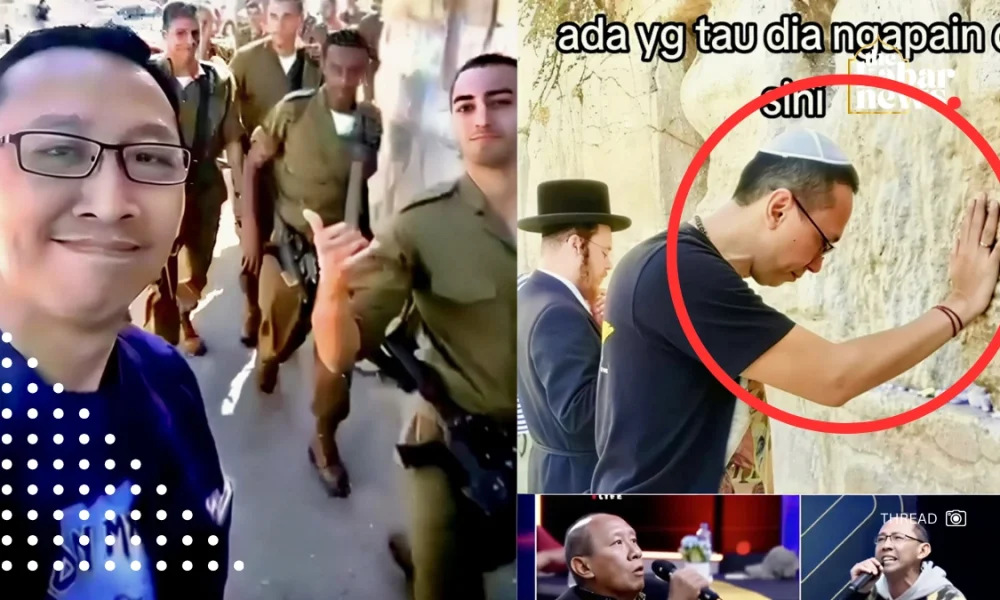
A few days later, an image purportedly showing him at the Western Wall in Jerusalem, one of Judaism’s holiest sites, sparked more online arguments about his ideas and background.
Netizens are now rejecting the influencer’s beliefs because of all the extra attention. This backlash is particularly in light of the controversial image and the heated discussions surrounding his views on religion and culture.
Abu Janda’s public profile says that he is a Muslim activist and a social media influencer. He wears a sarong and a peci (a traditional headdress) to public events or presentations to signify that he is a santri.
His religious credentials also link to his work with the NU’s Ansor Youth Wing (GP Ansor), one of Indonesia’s largest Islamic groups. Others think he is related to Banser. Banser is a volunteer paramilitary outfit that helps keep communities safe and puts on social events. It is often associated with promoting the values of moderate Islam. Abu Janda claims to support these values.
Abu Janda has claimed numerous times, both in person and online, that he supports moderate Islam. In Indonesia, moderate Islam is called Islam Nusantara.
He has also said more than once that people and ideas that are excessively extreme are undesirable. He believes that such extremism undermines the principles of Islam Nusantara and can lead to conflict rather than harmony, as it contradicts the core values of tolerance and coexistence that are essential to this moderate interpretation of Islam. Moreover, he emphasizes that moderation is vital to building peace and understanding within the community.
A Threads account called dewaaphrodite tweeted an image on March 11 that said it showed Abu Janda worshiping at the Western Wall in Jerusalem. Consequently, the tweet brought the situation back to life.
The Wailing Wall, also known as the Western Wall, is an essential feature of the historic Second Temple complex for Jews all over the world. But anyone can go there, no matter what they believe.
Netizens saw the statement right away on social media and started talking about it. Some people criticized the influencer, while others warned that viewers should be cautious in interpreting the picture. However, different individuals may have varying interpretations based on their biases and societal influences.
Such interpretations can lead to misunderstandings and further polarization in public discourse surrounding controversial figures like Abu Janda. This effect is especially notable in light of his recent conflicts during the argument “Perang Meluas, Kita Harus Bagaimana” (Expanding War: What Should We Do?).
Abu Janda attracted increased public attention following his appearance on the talk show “Rakyat Bersuara,” hosted by journalist Aiman Witjaksono.
Things grew worse when the former Indonesian ambassador to Tunisia spoke out against the US government’s foreign policy. The audience perceived this policy as controversial and inflammatory, which heightened tensions among the panelists and attendees.
When Abu Janda became angry during the discussion about the history of Indonesia’s and Palestine’s relationship, things got worse. They became increasingly concerned as the foreign policy dispute escalated.
The talk got more tense when it moved on to the history of Indonesia’s and Palestine’s relationship. Abu Janda and law professor Feri Amsari disagreed on the appropriate course of action.
He stated that there is a lot of proof that Palestinian leaders helped Indonesia struggle for freedom in the past. There was particularly diplomatic support and solidarity movements that were significant during Indonesia’s fight against colonialism. Notably, this episode occurred in the middle of the 20th century. Indonesia was attempting to get rid of colonial authority during that time.
There have been a lot more talks on social media since the picture and the TV debate. This trend is more common in Indonesia’s major cities, where social media discussions about public figures have surged significantly in response to recent events.
This instance showed how closely people observe public figures these days. Individuals online pay close attention to what they say and do. Often, people analyze their statements and actions in the context of current events and societal issues.






No Comment! Be the first one.